When Flags Become Blindfolds

As a student of history, I’ve spent years studying the many “isms” that shape how human beings see one another. Racism. Sexism. Fascism. Religious extremism. Some would add communism or capitalism, depending on where they stand. These ideas are widely recognized as destructive forces, systems that divide, dehumanize, and justify cruelty.
Yet one “ism” often escapes the same scrutiny.
Nationalism.
Across history, the urge to see your tribe, your country, your people as dominant or superior has caused more war, more suffering, and more mass death than almost any other ideology combined. And yet we rarely speak of nationalism in the same breath as fascism or racism.
Why?
Because nationalism is useful.
It is useful to those who wish to control populations. Governments need people to see themselves as fundamentally different from “the others.” National identity becomes a shortcut, a way to compress complex human beings into symbols, colors, and slogans. Political leaders wrap themselves in flags, sometimes literally. Totalitarian regimes always place the leader beside the national banner. The message is deliberate: the flag is the leader, the leader is the nation.
To question one is to betray the other.
As a child, I was deeply nationalistic. I had Union Jacks in my bedroom. I devoured history books about empires, battles, generals, and victories. I was, in many ways, a small Victorian Englishman in spirit, intoxicated by the romance of power and conquest.
But as I grew, something shifted.
Spiritual growth expanded my empathy. I began to understand that the wars I loved to study were not heroic abstractions but human catastrophes. War, I came to see, is a profound act of collective self-sabotage. I read the poets of the First World War and learned, in detail, how nationalism and militarism consumed an entire generation. I studied the rise of the Third Reich and the unspeakable cruelty carried out by a highly educated, technologically advanced society.
What unsettled me most was how recent it all was.
My grandfather was a teenager when Hitler rose to power. The great cities of Europe, cities that had blossomed for centuries, were reduced to rubble within a single lifetime. Millions of ordinary people were murdered through industrialized brutality. This happened after the Enlightenment. After science and medicine had flourished. After the greatest novels, symphonies, and works of art celebrating the human spirit had been created.
And yet, despite everything humanity knew, despite all it had built, less than twenty years after the madness of the First World War the world plunged into the greatest slaughter it had ever known. Nationalism, hand in hand with racism and militarism, led humanity into misery piled upon misery. Ordinary families, in every corner of the world, suffered and grieved.
For what?
Because everyday people, young boys, old men, mothers, daughters, were hypnotized into believing that other human beings were fundamentally different. Less deserving. Less worthy of dignity. Less human.
Cruelty, they were told, was necessary.
War is always brutal. Even democratic nations possess horrifying means of inflicting suffering. But the difference, and it matters, is that democracy places constraints on power: the rule of law, an independent judiciary, a free press, and the peaceful transfer of government through elections. These imperfect systems act as a leash on humanity’s worst impulses.
Democracy, as Churchill said, is the worst system of government except for all the others.
It is the best tool we have to establish universal rights and protect ourselves from the inevitable egomaniacs who seek power. It is an ongoing attempt to restrain corruption, cronyism, and personal gain, forces that have haunted human societies since the first ape lifted a stick over a weaker one.
History offers moments where democracy pushed humanity forward: Athens. Magna Carta. The Enlightenment. The American founding. The civil rights movement led by Martin Luther King Jr. These were not victories for flags. They were victories for ideas, the radical belief that power should be constrained and that ordinary people deserve dignity.
Ironically, it is these very moments that nationalism later tries to claim.
The American Revolution was not fought for a piece of cloth. It was fought against tyranny, against a government willing to kill its own people and excuse that violence by insisting that obedience would have prevented it. The British authorities argued that if the colonists had not protested, had not gathered, had not resisted, they would not have been shot in the snow at Lexington. We hear the same logic echoed throughout history whenever power kills and then blames the dead.
The colonists rejected that reasoning. They believed, rightly, that a government willing to murder its citizens without recourse was tyrannical. They went to war not for a flag, but for an idea: democracy.
And this is where the flag becomes dangerous.
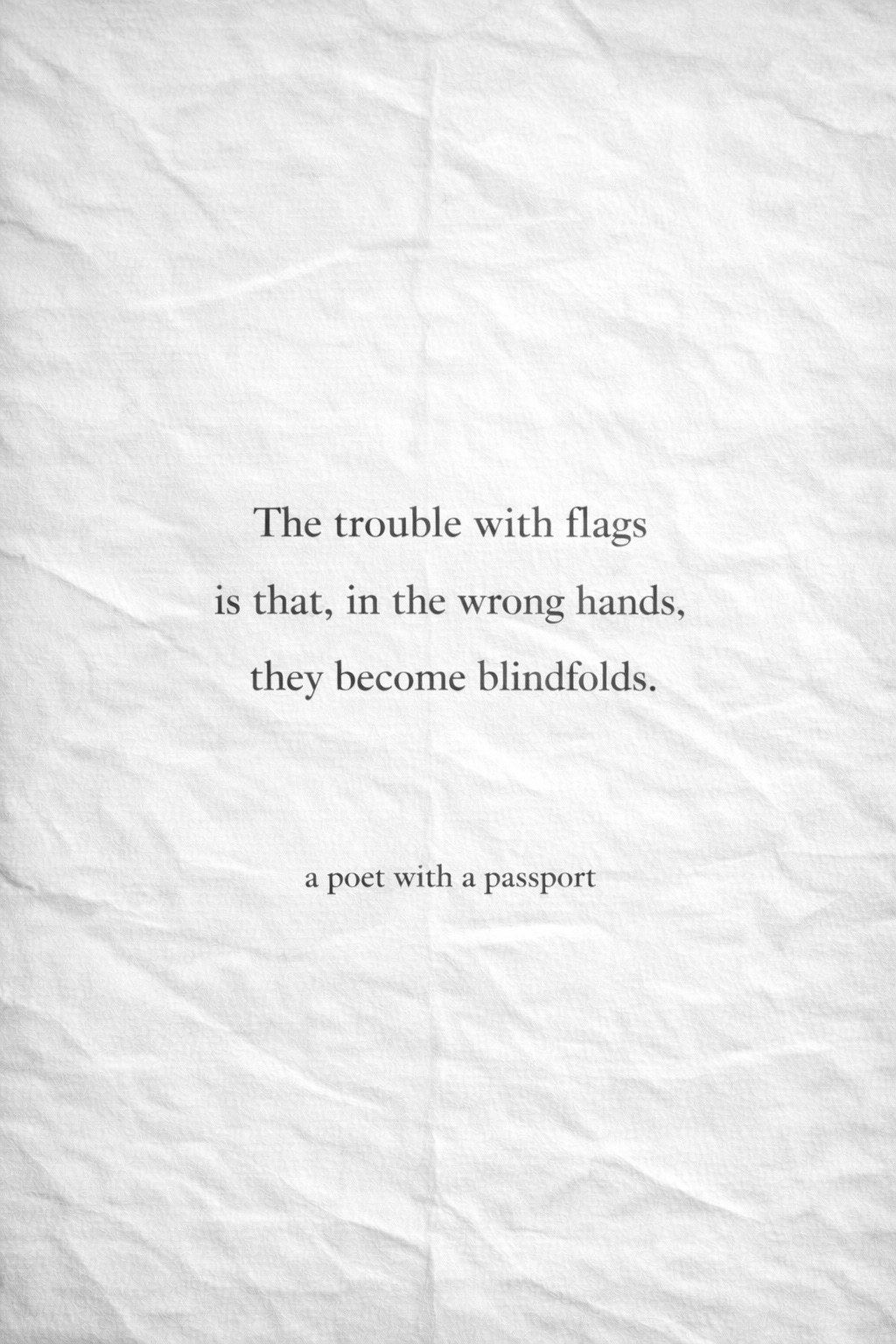
A flag on its own is nothing. In the wrong hands, it becomes a blindfold. It is used to convince people that those under one banner are fundamentally good, while those under another are somehow different, closer to animals, more deserving of punishment, more acceptable targets for violence.
The most terrifying truth is this: armies of terror are almost always made up of ordinary people. The Second World War proves this. The leaders were monstrous, but the legions who carried out their orders were not born monsters. They had parents. They loved music and sports. They fell in love. They had dreams.
Under the right conditions, they were taught to feel less empathy.
This was not because they were German, or Japanese, or communist. It was because they were conditioned to place entire groups of human beings into the category of “other.” Nationalism is often the first step in building that imaginary wall.
I believe we are people first.
When someone is suffering, you don’t ask to see their papers before helping them up. You don’t decide whether they deserve compassion based on their flag, their god, or the language they speak. You extend a hand because you recognize something familiar: vulnerability, fear, humanity.
Flags come and go. Borders shift. Europe alone has seen countless nations rise, merge, fracture, and disappear over the last three hundred years. What once required thousands of flags now fits under a few hundred. The truth beneath it all remains unchanged: we are someone’s child, someone’s parent, someone’s hope.
The danger is loving a flag so much that we confuse it with the person holding it, excusing crimes committed in its name while extending unearned loyalty to strangers simply because they were born under the same symbol.
A flag means nothing if the rights of those who salute it are gone.
The only lasting truths are freedom, law, dignity, and kindness, extended to all. Without them, there will ultimately be freedom for none.
All the things that divide us!! Really insightful and thoughtfully written article.